
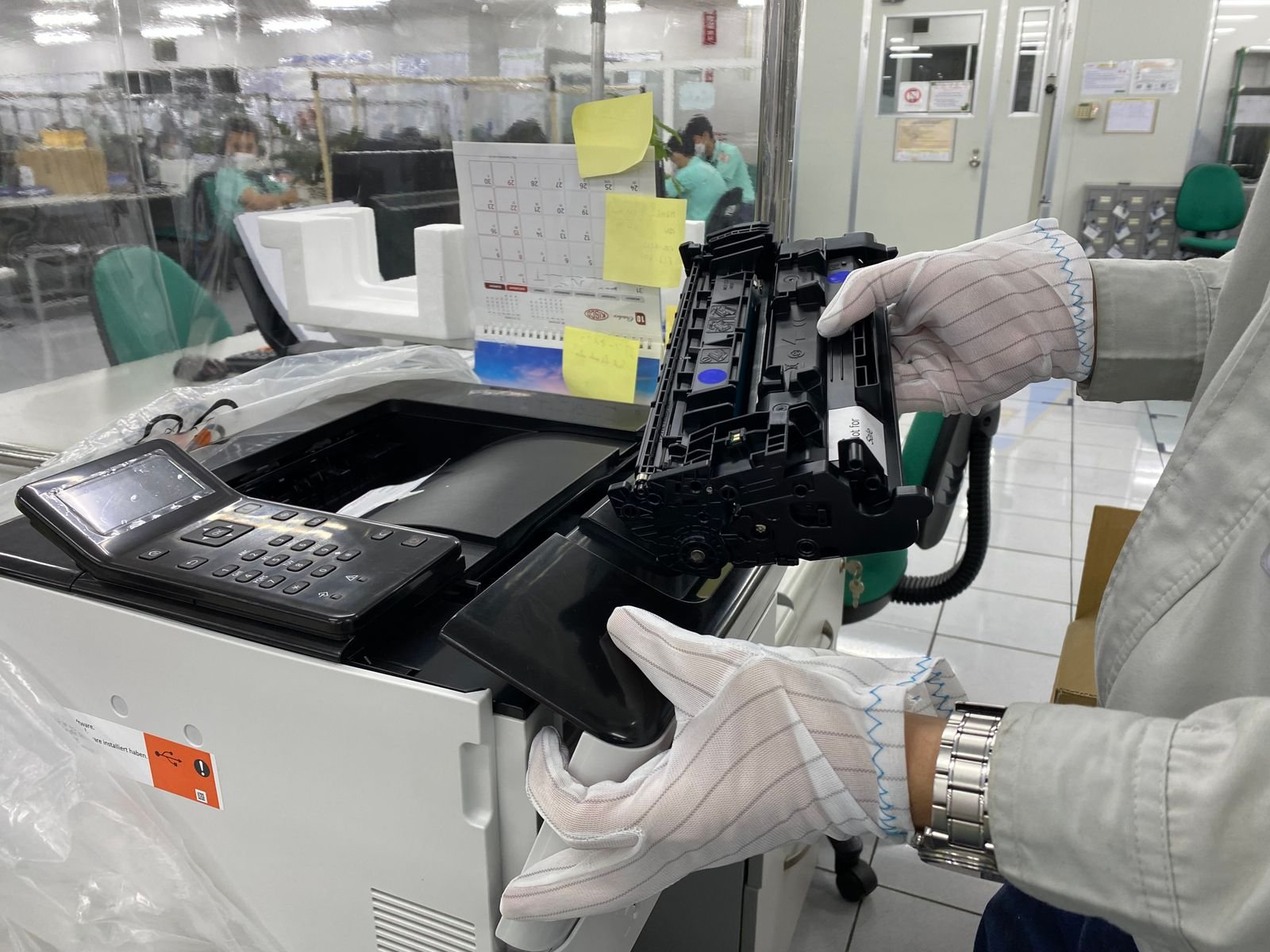
Print Quality & Yield: What Actually Separates a Reliable Toner Cartridge from a Problem

Your print shop just ran a rush job for a law firm. The text came out streaky. The client noticed. They noticed the smudging fix wasn’t fixed at all, and now you’ve lost a account that took three years to build. You switch cartridges, recalibrate the printer, run three test pages — and the defect shows up again. You pull the cartridge. You check the chip. It’s recognized fine, but the toner inside is clearly the problem.
This is the scenario print shop owners and procurement managers describe most often when compatible cartridges fail in production environments. It’s not a chip compatibility issue. It’s not a printer firmware glitch. It’s print quality — and specifically, it’s what happens when toner powder, fusing dynamics, and page yield aren’t engineered to consistent standards.
Most buyers in this situation do one of two things: they go back to OEM exclusively, or they hunt for the cheapest compatible cartridge they can find. Both responses are understandable. Neither is necessarily correct. The real question is how to distinguish a compatible cartridge that will perform reliably from one that will cost you in reprints, wasted media, and damaged client relationships.
Here’s what to look for, starting with the technical details that actually matter.
Why Toner Density Variability Causes Print Quality Problems
Print quality starts with powder physics. Toner density — the mass of toner per unit volume — controls how evenly it transfers from the OPC drum to the paper. If the toner density is too low, the output looks washed out, and fine text loses definition. If it’s too high, you get offsetting, background haze, and the toner smudging fix you thought you handled in your fuser settings isn’t a settings problem at all — it’s a cartridge formulation problem.
Inconsistent toner density between cartridges of the same model is one of the most common sources of print defects in compatible cartridges. A batch from one production run prints fine. A shipment from a different batch looks like it came from a different printer entirely. That’s not a printer problem. That’s a manufacturing consistency problem.
What drives that inconsistency? In large part, it comes down to powder milling and blending processes. Toner particles need to meet a specific size distribution — typically 5–12 microns for electrophotographic printing — with tight tolerances. Particles outside that range cause irregularities in transfer efficiency and fusing. Some manufacturers control this tightly. Others run open-batch processes that introduce variability every time the formula is scaled up.
At Enlite, toner formulations are managed through a 7S production environment with ERP oversight across all production lines. Our Zhuhai facility runs 13 fully automated production lines, with monthly capacity exceeding 1.2 million pieces. That level of automation reduces the human variables that cause batch-to-batch density swings.
For buyers evaluating a compatible supplier, asking about powder milling tolerances and how they manage formulation changes between production runs is more useful than asking whether a cartridge is “high quality.” Quality is a result of process. You want to know what the process is.
What “High Yield Toner” Actually Means — and What It Doesn’t
High yield toner cartridges are a standard offering across the compatible market. Manufacturers achieve higher page yields primarily by increasing toner fill weight inside the cartridge. A standard-capacity cartridge might carry 20–30 grams of toner. A high yield version of the same cartridge body might carry 40–50 grams, depending on the OEM design.
This sounds straightforward, but it introduces a physical constraint: toner transfer efficiency and fusing are calibrated for specific weight and coverage expectations. If a cartridge is overfilled without accounting for the drum’s承受能力 and the fuser’s thermal profile, you see two failure modes. First, excess toner spills onto the OPC drum and causes ghosting or backgrounding. Second, the fuser works harder to bond the heavier toner layer, accelerating wear on fuser rollers and increasing the risk of hot offset — toner sticking to the fuser and transferring to subsequent pages.
The other variable is toner consumption rate per page. High yield toner formulations can use different chemistries — lower melt point polymers, modified surface additives — to maintain transfer efficiency at higher coverage. Not all manufacturers invest in that optimization. Some simply add more toner to the same formulation and call it “high yield.”
When evaluating high yield options from a compatible supplier, the relevant questions are: what is the tested page yield per cartridge, and what test protocol was used? Note that the ISO 19752 page yield standard was developed for and applies to original equipment manufacturers. Compatible cartridge manufacturers cannot legitimately claim ISO 19752 certified yields. Enlite reports toner cartridge page yield figures based on internal QA testing — specifically, our internal test protocol evaluates each cartridge model across a standardized 5% coverage page, measuring output pages until the machine signals low toner or print density falls below a defined threshold.
That transparency matters. A supplier that will not explain how yields are measured — or that claims ISO certification it cannot hold — is a supplier that may be overstating performance across the board.
The Toner Cartridge Test You Should Run Before You Buy in Bulk
Before committing to a new supplier, run a toner cartridge test that simulates your actual production environment. Don’t rely on a single test page. Don’t rely on a sample printed in ideal lab conditions.
The test protocol that tells you the most is a multi-step process:
- Baseline your OEM cartridge. Print a 50-page reference set with your current OEM cartridges. Document density readings on a calibrated densitometer for solid black areas and halftone gradients. This gives you a measurable reference point rather than a subjective judgment.
- Print the same reference set with the compatible cartridge under evaluation. Compare density readings directly. A difference within ±5% on solid black density is acceptable for most commercial print applications. Larger deviations suggest formulation or transfer issues.
- Run a sustained yield test. Print at least 500 pages at your typical coverage level. Many defects — toner smudging issues, gradual density decay, backgrounding — don’t show up in the first 20 pages. They emerge as the cartridge depletes and the drum’s charge potential shifts under reduced toner flow.
- Test across multiple machines if possible. Chip communication, drum wear patterns, and fuser interaction all vary between units of the same printer model. A cartridge that performs well in one machine may expose issues in another.
- Inspect drum and fuser condition after the test. If you see toner buildup on the drum’s edge seals or darkening on the fuser roller, the compatible cartridge is generating excess debris. Over time, that debris causes defects in subsequent cartridges and accelerates wear on the printer.
Enlite provides sample cartridges for buyer evaluation. Buyers who run structured comparison tests before placing bulk orders consistently report higher satisfaction and fewer mid-job failures. The investment in a proper toner cartridge test protocol is small relative to the cost of a failed print run on a client deadline.
Certification, Traceability, and Why They Matter for Print Quality
Print quality is ultimately a manufacturing discipline, not a marketing claim. The difference between a cartridge that performs consistently and one that doesn’t comes down to how the supplier controls inputs, monitors processes, and responds when something drifts out of spec.
Third-party certifications provide external verification of a manufacturer’s management systems. ISO 9001 certification indicates that a supplier has documented quality management processes, conducts internal audits, and maintains records of non-conformances and corrective actions. ISO 14001 applies to environmental management — relevant because toner waste and chemical handling in manufacturing have downstream quality implications. SGS testing and OEKO-TEX ECO PASSPORT certifications address chemical safety and environmental compliance, which are increasingly required by buyers in European and North American markets.
None of these certifications guarantee that every individual cartridge will print perfectly. They do indicate that the manufacturer has systems in place to detect and correct deviations before they reach the customer. That’s a meaningful distinction when you’re evaluating a compatible supplier against an OEM alternative.
Enlite holds six certifications — ISO 9001, ISO 14001, SGS, OEKO-TEX ECO PASSPORT, CE, and REACH — all verified by external auditors. CE covers the conformity standards required for products sold into the European Economic Area. REACH is the EU regulation for the Registration, Evaluation, Authorisation and Restriction of Chemicals, and applies to any article containing substances of very high concern. For distributors and OEM buyers shipping into Europe, REACH compliance is a hard requirement, not a marketing line.
Buyers in regulated industries — legal, financial, healthcare-adjacent print services — increasingly require supply chain traceability as a condition of purchase. This is not a premium feature. It’s a baseline expectation for B2B procurement.
Making the Decision: What Your Evaluation Should Focus On
The choice between OEM and compatible cartridges is not binary, and it is not a bet on marketing language. It is a sourcing decision that should rest on measurable criteria: production consistency, QA protocols, yield reporting methodology, and supplier traceability.
Before you re-order on habit, run the comparison test. Evaluate the compatible cartridge against your OEM baseline on your machines, at your coverage levels, across your full print volume. If the density readings are within your tolerance and the page yields are what the supplier states — verified by their own documented test protocol — you have a data-driven basis for a sourcing decision.
If you want Enlite to supply that evaluation, we can ship sample cartridges and provide the production batch details and QA documentation for your review. Our team works with distributors, print shops, OEM procurement, and office supply wholesalers. We export to 80+ countries from our Zhuhai facility, with 13 fully automated production lines and monthly capacity of 1.2 million pieces.
Contact Enlite to request samples and discuss your volume requirements.
- WhatsApp: +86 15992688079
- Email: sales@enlite-china.com
- Web: enlite-china.com